


The term logistics is used today in almost all branches of business – from production and trade to e-commerce and international transport. But how did it come about, what does it mean and why is it so important?
In this guide, we explore the history of logistics , its meaning and role in modern business .
What is logistics and its meaning?
The word logistics comes from the Greek word logistikos – “skilled in calculation”.
Today, the term logistics means:
Planning, management and control of the movement of goods, information and resources from the producer to the end user.
➡ In short, logistics means: the right goods, at the right time, in the right place – at optimal costs .
If you are interested in more about freight forwarding itself and the role of freight forwarders in the international transport of goods, read our blog .
History of logistics through different eras
The development of logistics is closely related to people’s need to organize resources and transport.
- Ancient times – in Greece and Rome, logistics was used primarily for military purposes: supplying military units with food, weapons, and equipment.
- Middle Ages – merchants and caravans develop the first systems of exchange and storage.
- The Industrial Revolution – railways, steamships and later trucks enable the expansion of international trade.
- 20th century – World War II brings enormous progress in military logistics, and after the war, the methods are transferred to the business world.
- Today – logistics is transforming into a global supply chain management system , supported by digital technologies and automation.
📌 You can find more on this topic and how companies use logistics here .
Business logistics today
Business logistics is no longer just transportation – it encompasses all processes that connect manufacturers, distributors and customers.
Key functions:
- inventory management
- storage and distribution
- packaging and handling of goods
- transport coordination (road, sea, air, rail)
- digital real-time shipment tracking
Main elements of logistics
- Transport – the most visible, but only one of the elements.
- Storage – inventory control and space optimization.
- Distribution – organization of delivery to the end customer.
- Information flow – monitoring and planning systems.
- Supply chain – connecting all stakeholders: manufacturers, freight forwarders, carriers and customers.
Why is logistics important in modern business?
- Reduces costs by optimizing transportation and inventory
- Increases competitiveness through faster and more accurate delivery
- Improves customer experience with timely deliveries
- Supports global trade through international supply chains
👉 Read also: What forwarders expect from carriers .
Logistics transformation
The role of globalization
Globalization has increased the demand for efficient logistics systems. Companies today use innovative methods such as “just-in-time” delivery to reduce costs and increase efficiency.
E-logistics and digital transformation
With the development of e-commerce, traditional logistics is increasingly giving way to digital solutions. Digital platforms enable real-time tracking of shipments, reduced administrative costs, and better coordination of all participants in the supply chain.
FAQ: History and meaning of logistics
Q: What is logistics?
A: Logistics is the process of planning and managing the flow of goods, information and resources.
Q: What is the difference between freight forwarding and logistics?
A: Freight forwarding is a narrower term, focused on transportation, while logistics encompasses the entire supply chain.
Q: What are the main elements of logistics?
A: Transport, storage, distribution, packaging and information flow.
Q: When did modern logistics develop?
A: After World War II, when military models were transferred to the civilian and business sectors.
Conclusion
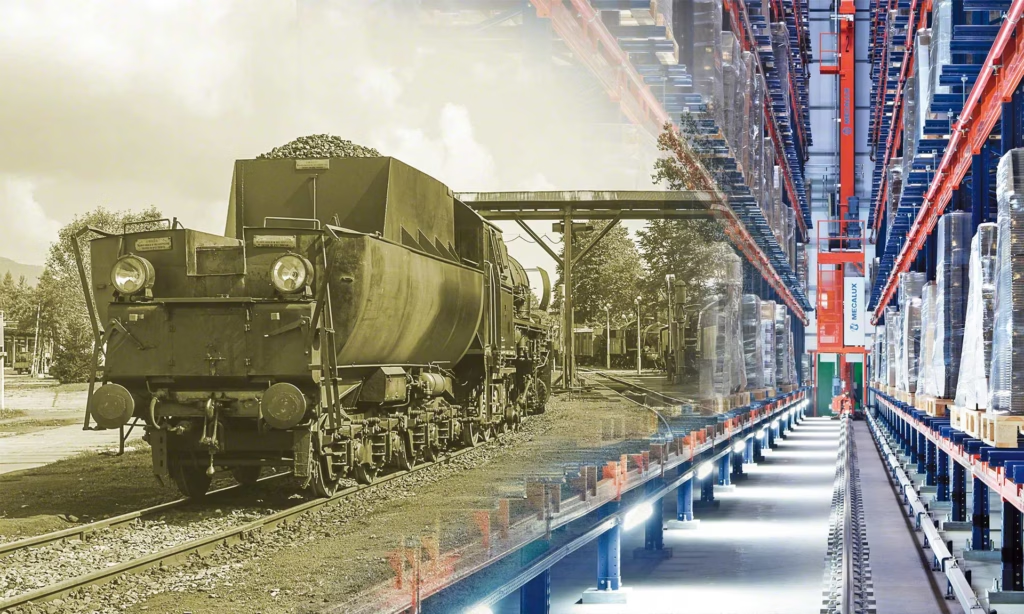
From ancient military campaigns to modern global supply chains – the history of logistics shows how crucial it is to the development of society and the economy.
Today, logistics is the heart of every company involved in production, trade or transportation.
👉 HUBBIG digital platform connects forwarders, carriers and clients in one place – making logistics faster, more transparent and more efficient.
Learn more at hubbig.com .

